Friday, November 5, 2021

Hiring Red Flags, or why Kevin O'Leary of Shark Tank is a Likely Asshat

Beware the Omniscient
I saw this headline this morning.

"When Kevin O'Leary sees this resume red flag, 'I simply put it into the garbage'

What's the red flag for this bit of clickbait? 

When the applicant has held a number of jobs over the previous two years.

Ya see, ol' Kev is too smart to commit to People Like That. Companies that hire people are making Commitments, you see, and anyone who has a number of positions on their resume is simply a Job Hopper, devoid of personal loyalty, and just not A Good Person. Do Not Hire. Let 'em starve.

Leading to the following thought.

Hey, Kev, how long have you been omniscient?

Or, failing that, someone who practices in generalizations and avoids thought and due diligence?

If there is one thing that I've learned in 20+ years in marketing and advertising, at a number of start ups and for hundreds and hundreds of corporate and personal clients, it's this: 

There is (almost) never (just) one thing. In anything. 

Yes, I'm sure that many people with short stops on their resume were job hopping for reasons that a future employer might not love. Or an unwillingness to start a potential new position with a lack of integrity. 

Others had medical issues. Or family complications that required an exit. Or found themselves in a situation where their employer had a sudden downturn, or a particularly awful incident, that was in no way the responsibility of the applicant. 

There's going to be a lot of these people, what with the pandemic.

You know, the one you just summarily dismissed, rather than do any goddamned work. Or considered anything but the most negative possibility, because You're Too Busy or Smart or Picky or Whatever.

In my distant past, I took a job with an employer that I was super excited about. I did my due diligence to the best of my ability, won the role, and found myself in the CEO's office late on a Friday afternoon just a few weeks after I started.

Which is when he decided to close the door so that just the two of us could have a very serious and heartfelt conversation about Jesus. (Spoiler Alert! That role did not last long or end well.)

Leading to a situation where, in Kevin O'Leary's World Of Red Flags and Red Flags Only, I was a (sting music!) JOB HOPPER. Leper Outcast Unclean! 

(And yes, I should have done better research about this guy and that place, but show of hands -- who has ever had this happen to them as well?)

Oh, and it turns out that O'Leary has also bounced from gigs in his past life, and subscribes to political views that make him, shall we say, highly suspect in certain circles. 

So I can probably pull the Likely from the header of this post... but won't. 

Because, you see, I'm not omniscient. Or an asshat. (Hopefully.)

So if you have an applicant that you like with a number of positions on their resume, you *can* throw that in the garbage. It's a free country.

Or you could, I dunno, ASK THE APPLICANT ABOUT IT. See if they put your fears to rest. Consider the entirety of the candidate. 

Because in the new World of Work, where applicants have options and labor is tight?

You just might need to look past your Red Flag.

That might not even be a flag.

Thursday, October 21, 2021

The Trends In Our Stars

I was reading a trends report (not going to say whose) the other day, and it triggered a few thoughts. In no particular order...

> Brands that never touch political issues are projecting fear and/or complicity. They also could easily lose out on marketing to young buyers who aren't purely focused on price (i.e., the buyers they want). The math for high growth is with the brave, folks.

Perhaps you think corporations that beat their chest about sustainability are just virtue signaling. Maybe you are skeptical about eco-first products as just different items in the landfill, or that privacy is a myth in the current era. But the reality is those views aren't going to help you with new to market in beauty, banking, or a host of other categories where younger consumers are forming buying trends that will last a lifetime. 

> High-growth brands stand for things. Consider the doom saying for Nike when they took on Colin Kaepernick; hasn't hurt the brand at all. (Massive understatement.) Or Patagonia and the North Face on opposing the climate policies of the previous administration. You'll likely see the same thing with vaccine mandates moving forward. Whether this relates to, say, a talent walkout at Tesla for moving to Texas despite (or because of?) the actions of the Texas Governor and Legislature, or people opting out of Florida travel, is a wait and see moment. But once again, safe decisions may not be, well, all that safe. Stand for nothing? Fall for anything.

> Diversity isn't optional. (Even in small teams.) I've worked at companies that failed on this mark, and, well, they weren't good places to work. It's becoming increasingly uncomfortable when a workspace is behind the times on this, and teams that aren't diverse are just more likely to miss points (or, maybe even worse, veer deeply into cautionary tactics and go too slow). 

> There's going to be math. More and more businesses are looking at creative with a need to know how they performed, which can be problematic for a host of reasons... but the core of the idea is sound, even if the execution isn't always nuanced enough. I can tell you from personal experience that when you used to talk stat sig with creative personnel, many of them looked at you as if you were scary and in the wrong room. Now, they are interested (and, well, still scared). Besides, once you take the math toothpaste out of the tube, it's not going back in.

> You probably should stop thinking about linear customer journeys. The idea that you can roll out a campaign by channel and "know" that such and such a piece is going to close the deal... well, I get that the Old World has its charms, but it's not coming back, folks. Your prospect is going to mix and match channels and platforms to their taste (some social, some search, some email, some will see display, broadcast, podcast, etc.), and that dumb thing you were doing with last-click gets all the credit... well, it's even dumber now. Measure everything, but know that nuance and brand development likely exist outside your spreadsheet.

> Marketing people are being forced to collaborate (whether they want to or not). This has been accelerated by remote work, which is lonely and harder to QA. 

Point of order: during the writing of this piece, I wound up having to drop everything for an hour to deal with laundry, pets, a cleaning project and food prep. No wonder the QA's harder, yes?

It's also harder to work this way, since you can't read body language to go softer or harder on decisions. This could also be a factor in the Great Resignation trends among junior levels. But the plain and simple is, as it's always been -- great, fast, cheap. Pick two, and collaborate accordingly. 

> It's all getting faster. I'd say more about this, but, well... is anyone really disagreeing?

Friday, October 15, 2021

Five Good Minutes

 The folks at Daily Ad Brief reached out to discuss the future of online advertising and such. Take a view (and see if you can find the Easter egg mistake).


Tuesday, July 6, 2021

Five Half Year Takeaways

Folks -- Thanks to terrible Web hosting service and three high volume clients, we haven't had much of a chance or ability to add to the blog recently. So consider this to be a six-month catchup of what we've learned by doing.

5) It's a 2 (Point Five?) -for-1 year.

From my spouse's harp work to email copywriting and event planning, the pent-up demand from 2020 is just causing a lot of asks in a short period of time. 

It's not that everything is fine and dandy now -- supply chains are still a mess, shortages and price spikes are giving pause, and the specter of a Covid backlash from the Delta variant and over a year of big fear is keeping some still on the sidelines -- but the thirst for doing is strong.

4) Email is going to have seismic shifts.

Open rates have been under siege for a while now, but with third-party cookie verification being put on a slow track to extinction, that metric is going to become pointless. Judging emails just by click rates is going to take some air out of channel, and creative personnel are not sitting on AR/VR assets and best practices to juice the CTR. Combine this with ever-shrinking use of the channel by younger and time-stressed users, and you've got bad times for an old reliable channel. (Short term, at least.)

3) For many, the pandemic is firmly in the rear-view mirror.

I was at a corporate event in late spring that was scheduled for an outdoor space to be Covid safe. During the event, persistent rain kept everyone inside... and they all packed together, talked loudly to each other (you had to), and more or less went back to 2019 in minutes.

Sure, maybe the event was already pre-populating with people who were vaccinated and confident, or just starved for IRL companionship. But this wasn't a small crowd, or a timid one. 

2) Antitrust is having a very large moment.

There are a number of bills in Congress right now that actually have bipartisan traction as both political parties have an axe to grind against (Very) Big Tech... and almost as if they were hoping to pull off one more big heist before retiring, Apple and Google and Facebook have all moved to control ad targeting (while shutting it down for others).

It's always safe to bet on inertia when Congress is involved. Until, well, it isn't.

1) Retargeting was math-smart and world-foolish, with pain to follow.

If you judge creatives strictly on last-click attribution (hint: do not do this), then you probably wound up approving art that looked a lot like Criteo for most of the last decade -- which is to say basic and utilitarian dynamic boxes with a creepy 30-day stalker window of a product that you almost bought but didn't.

By the math, you were smart to do this, because hey presto, more clicks for this, less for everything else. Good for you with your math skills.

But you also find yourself in 2021 with the public *hating* your ads and that targeting method, so much so that there is popular support for giving even more negotiating power to the richest companies in the world?

Well, um, maybe there's more than math to this. Maybe you should have looked at capping frequencies, or running second-best executions more often to limit burnout. Maybe you could have cut into that 30-day magic window and looked at tighter times (yes, 7 and 15-day for most consumer categories). 

I'm not sure what's the next move to make for this industry. Criteo's not going to go away without a fight, and people aren't going to lose their most effective creative by math without complaint. But if your way to do this goes away, or people expect it to go away and complain to their platforms... 

Well, once again, things that can't continue eventually don't.

* * * * *

If you'd like to talk to us more about any of the above, feel free to reach out. We've got bandwidth and even more tricks up our sleeves than before.

Best -- DMt

Tuesday, June 29, 2021

Hello Again, And Yes, We've Had The Worst Site Hosting Service Imaginable

Sharp-eyed readers of the blog will note two significant points in the publication of this here blog-like product. (Actually, not even sharp-eyed.)

Point one: The URL has changed. (My name plus blogspot.com, not M&AD. It was too long anyway, I guess.)

Point two: It was several months since the last update... because I've spent that long just trying to get the site back online at the old URL.

These are related.

Here's the story... as a person with decades in the space, I have a long history of buying URLs. I've never really thought too much about it. So I used Register.com back in the day, and have kept using them because inertia.

That web site isn't around anymore. They've sold it to web.com.

How good is web.com? Well, here's the link to the Yelp review. Just to prove it's not just me.

17 reviews, all of them a single star, most of them wishing for legal action.

It takes work, honestly, for not a single reviewer to give you more than the minimum. It also shows that you so don't give a damn about your reputation that you don't even file a fake review on your behalf.

I'd say more about this customer service experience, but honestly, I've wasted enough of my life on these people, and so have you from reading these words.

Anyway.

Blog's back up, thoughts later. Sorry we were away. Back in a bit. Lots of work being done and lessons being learned...

6/29 Update: And now we're back at the old URL. Moving on, folks...

Sunday, April 4, 2021

Here We Go

 I want to tell you about one of my favorite things in the world.

I could do this very badly with numbers. Here, I'll show you.

2 - minutes

45 - miles per hour

73 - years old

78 - feet high

$1.5M - cost

Now, the better way.

The Phoenix is a wooden roller coaster at Knoebels, a century-old amusement park in the middle of Pennsylvania. It goes up and back, causes you to float out of the seats, seems impossibly faster at the end and once you ride it from the very front or the very back in your dozens of times in riding it, you'll never take the middle again.

OK, some more words of explanation. 

Knoebels is a family run place that's free to enter, free to park, and the lines are never really very long because for heaven's sake, you are in the middle of Pennsylvania. I think I've probably ridden this thing a few dozen times, in the day and night, in hot and cold, in drizzle (the best; it's even faster) and dry. 

It's a smile machine. Everyone is smiling on the ramp as they leave it. It's magic.

And no matter how many times you get dragged up that hill -- you know the drag, the chunka-chunka-chunka of the chain sounding like oh dear Lord this is the time that it's going to break, isn't it, and the nerves and the adrenalin kick in and you become the person that you were the first time you rode it, rather than the person you are now, if only for those two minutes...

You are present. You are aware. 

You are not thinking about lunch or dinner or the mortgage or your in box or your calendar or the healthcare check or the pets or the water heater or the government or anything, really, beyond the chunka-chunka-chunka.

There are very few things in the world better than the Phoenix. (Short list? The laughter of my wife and daughters. My dog when he's asleep or catching a frisbee. Joel Embiid. This list subject to change.) 

But in business, there is very much one thing that's better than the Phoenix.

And that's the feeling you get when the chunka-chunka-chunka stops, and the glide starts, and you look down the hill of knowing that everything is about to get very, very much faster.

We've had days of over 4 million vaccinations. The unemployment rate is dropping. Cash is rippling through the country from stimulus checks and pent-up demand. Airports are filling up, perhaps too soon for pandemic safety, but filling up just the same.

Enough people are getting vaccines, or more darkly have had the damn bug already and lived to produce their own antibodies, that the fear of a new wave is likely greater than the reality.

Personally, M&AD has had clients with urgent needs, all of them reading the tea leaves the same way we do. The sports laundry I root for both had home games today, both won, both in front of vocal but responsible crowds that made everything seem just a little bit more like the Before Times.

We're getting dragged up that hill, folks.

After 13 months of too long and too dumb and needless tragedy and I'm skipping the recap, we're in glide, in the last few seconds before Fun.

And no matter how many times you've ridden the ride, this moment is the best.

Hold on tight!

Tuesday, March 9, 2021

So Good You Can't Say

Ironic Meme Not Included
This month, one of my clients released something really great. It took them years to make, fulfills a need in the marketplace that was underserved, and flat out dunks on everyone else in the category. Their core group of customers and fans are spreading the word about it on social media, because it's in a category and demographic where word of mouth and an urgent buying cycle are both strong realities. 

So why am I telling you about them while not really telling you about them?

Well, because...their experience is striking, educational and if you look at it the wrong way, a little dispiriting. 

Here's why.

The product and service has a strong Reddit channel. If you don't know Reddit, Wikipedia defines it as a social news aggregator and discussion web site, where registered members submit content that is up or down voted by other members. 

Also, if you didn't know about Reddit... well, there is no point in being mean about it. You probably knew about Reddit. You are reading a marketing blog, for heaven's sake. It's Yelp for everything that Yelp isn't for, basically.

Anyway... as previously stated, the new product is great. Not my opinion; pretty much everyone's. So is the service that supports it. The market, which skews young, is really enthused about it. And not shy about singing its praises to the skies. 

Which means the posts get cynical admins casting aspersions as to gaming the system or writing fraudulent content, because we didn't just fall off the turnip truck here... you folks are scammers, right? Let's just assume scammer first and ask verification later.

Or competitor trolls doing what trolls do, because hey, trolls gonna troll.

This is likely just a temporary problem, and a pretty good one to have, really. Eventually the persistence and true organic nature of the positive commenting community will outweigh the haters. Competitors in the space will step up their game or perish. Competition and capitalism and the such will have its way.

But in the meantime?

We get to patiently explain to the most tiresome people on the planet why nice things can still exist in the world. (Without sounding like scammers or religious zealots.)

All while being profoundly grateful that we don't have to live in their world for very long...

Play me out, Modest Mouse!

Thursday, February 4, 2021

I Only Care About One (Wrong) Thing

Sometimes as a consultant, you get a client who is monumentally frustrated by a single metric. It's resisted previous efforts at optimization, it's deteriorated in a way that's threatening employment, and it's all anyone can talk about.

In a moment like this, you have to *very* careful and stick to your integrity... because to be honest, there are a *wealth* of black and gray hat tactics that will "solve" the problem for any single metric. And if your client keeps hammering away on a fix, you might even be tempted to use them. But they only create, well, much bigger problems.

Open rates in email an issue? Change your sender name to something salacious, or tweak the subject line to oversell a benefit or personalization. Sure, you may lose in-boxing, get booted by your provider, and unsubscribe and bounce rates will spike, which are all way much worse problem to have, but hey... you only wanted to fix the open rate, right?

Let's go further down the funnel, then -- clicks are tried, true, and never high enough to make everyone completely thrilled. OK, dumb everything down to a single entry point (for old-time fans of the blog, the Jolly Candy-Like Button), make the call to action pop to the point of obnoxiousness, and prevent anyone involved from analyzing site behavior or caring about click quality. Bonus: show the ad in a new geographic area for the consumer category, even if it's impossible for them to make a purchase. Voila, CTR is spiking! Not conversions, though. Definitely not conversions.

Well, fine, Mr. Black Hat Consultant... let's only measure for conversions, then. That'll fraud-proof it! Except that in making this move, you've likely made testing impossible due to the rare event issue, made everything dependent on a conversion funnel that is likely independent from lead generation, and given everyone involved a massive incentive to sell on an irresponsible price point and forget about return on investment or lifetime consumer value. If you are only measuring on conversion, well, converting on a loss leader isn't really that much of a trick. (I'd get into SEO here, but the black hat work there is so prevalent, it's honestly hard to sell honest services.)

The point is this: life (and marketing) is often *complicated* and a complex problem to solve. Trade offs are inevitable. There are very few things where you only want to know one metric, and are ready to toss all others out the window. If the only thing you care about is how fast you are going when you drive, you're going to run out of gas. Or fail to heed the check engine light. Or drive through a red light while you stare at that speedometer.

Marketing and advertising is the same way. A long-term marketing professional wants to see as much actionable data as possible -- because they give us clues for how to make things better. Find out what site behavior says about click quality. Work out what platform someone is viewing your offer on, and how they index demographically. Grind away on small but free levers like dayparting, frequency, segmentation and so on, and so on. And when you measure for impact, look at more than one point in the funnel, if only to check that your gain in one place isn't being wiped out by a loss somewhere else.

Any marketing and advertising consulting agency should be able to help you solve your most pressing problem. But if they do so without making sure they aren't creating others, that's not good or sustainable service. 

Saturday, January 23, 2021

Strong, Not Optimal

Occasionally when you talk to a client, they give you clues as to how the relationship is going to go later. But only if you know what to listen for. 

One of the most telling, in my experience, is whether the terms they use show the right amount of intellectual curiosity and complexity... or whether they are hoping to keep things as simple as possible, even if this leads to a drop in performance due to a lack of rigor.

Words, in short, matter.

Which leads to the curious quest for Optimal Creative practices... 

That, well, do not exist. At least, not eternally.

Now, does this mean that there aren't strong and weak tactics? Of course not. You may be using many strong practices already, from calls to action to front loaded subject lines, from easily parsed body copy to entry points above the fold and a clear offer hierarchy and so on. 

I could go on, but there's a lot of channels, a lot of strong and weak practices, and that's not the point of this little exercise.

But no creative practice -- not even the ones that I would be truly shocked to see fail, mostly because I've seen them win in thousands of executions -- is optimal. 

That's because they can't be. 

Optimal implies perfection, unchanging, unquestioned. Can't be improved. And that's just not what occurs in creative testing. Everything can eventually fail, go stale, become overused by competitors or frequency, to the point where it's absence could be a better idea than it's presence. And everything can improve, see a boost from better execution or timing, or relative rarity in the market.

There are no optimal practices. There are simply strong ones and weaker ones, points you are more likely to see a benefit from testing and ones that are (probably much) lower priority to test.

There is no Magic Formula or Holy Grail or Perfect Ad. And if there were, it would cease to be with a quickness, because it would be duplicated and driven into the ground by everyone in a similar market.

And if your client doesn't get this, uses the terms optimal and strong interchangeably, or doesn't seem to want to get into the nuance, or live in a world where testing and data drives, instead of simplistic opinions that reinforce their own sense of being a Marketing Super Genius?

Then you don't have an optimal client.

Or a strong one.

And, if past precedent is any indication, a long term one...

Wednesday, January 20, 2021

And... we're back!

(Nope, not a political post. Thanks for asking!)

It's never good when a content blog goes quiet for a long time, but since we've last put words to electrons, M&AD has...

> Worked on several start ups with NDAs (but I can say that we now know *way* more about medicinal cannabis and personal protection equipment than we used to)

> Completed a long-term contract with Creative Circle working for Google (and yes, that was also Highly Educational), and

> Executed exploratory calls on several new exciting initiatives in new consumer categories for us (and honestly, after 20+ years in the game, when something is new to us it's Downright Exciting)

All of which would be very, very cool if it made for more short-term billing, which it has (at least so far) not.

So... ping us! Bandwidth available, at least for a limited time. 

With fewer exclamation points in person.

Talk to you soon...

Sunday, January 26, 2020

In The Succulent Belly Of The Beast


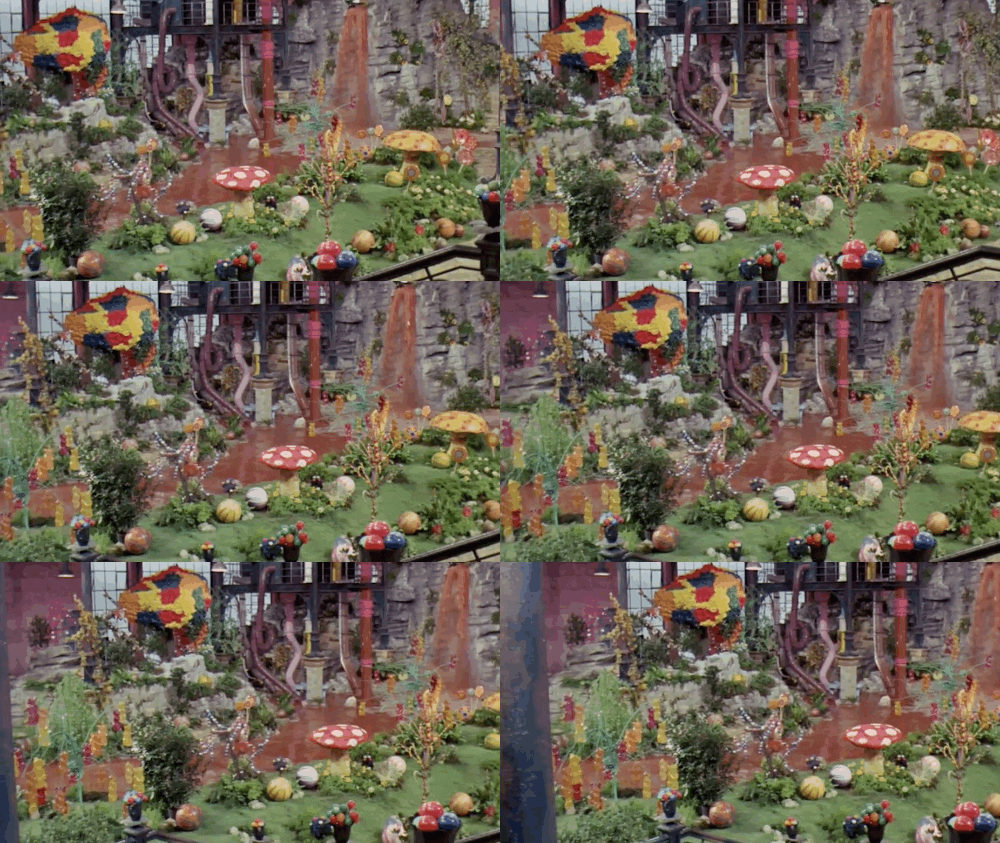
Image result for wonkaland
Not My Office, But A Reasonable Comp
First, the good news. For the past three weeks, and hopefully for a long time to come, I've been working a pretty fascinating contract job for a pretty Fascinating Employer.

They've brought me in for specific expertise that others do not have, and so far, it's been going really well. I'm a lot happier in this role than most of the gigs I've held in my life, my manager is incredibly nice and supportive, and the corporate culture is *astonishingly* better than some of the experiences that I've had.

Now, the bad. I can't say very much about it, really. I don't work for the Fascinating Employer; I work for a contracting company that sends people to the Fascinating Employer. Which means that while you get many of the bells, whistles and trappings involved, you don't *really* have the same status, and if you are wired like me, it also makes you *very* aware of how much you want to keep that status or better moving forward.

I also can't really get into any of the details of the Fascinating Employer's ample and over the top perks. So the moments that make my 9 to 5 feel more like Wonkaland, rather than just another office... well, the details are going to be lacking, because they have to be.

But I can, of course, hint.

I didn't think that the perks were this going to be that much of a deal, folks. I'm a grown up. I've worked at any number of start ups with any number of Costco-infused snack rooms, with the inevitable HR-driven cupcake and donut fetish, with the Oooh So Naughty cheap thrill of beer in the fridge for Friday Wackiness. If you've been in offices with ping pong and foosball tables and after-hour Work Drinks and off-sites at nice restaurants, it starts to feel like every other place.

All of that stuff becomes table stakes with a disturbing quickness, and the relative lack of variety and Hey, I Can Go To Costco And Get My Own Grub means that you still see people stomping off to Starbucks or into town because, well, food.

And then there's what the Fascinating Employer does, and... yeah.

I used to think I had personal discipline, folks. Thankfully, the Fascinating Employer is staffed head to toe with young and in shape people (many of them who avail themselves of the in-office workout equipment), all of whom subtly remind you that you are not the weight or age or height or skin quality that you want to be, so maybe mix in some (impeccable and astonishing) salad with your truffle-infused triple chocolate salted caramel and garnished with real unicorn shavings brownie. (Not a real thing, but you get the point.)

So just have some fruit, right? That's good for you and they can't do that better than everyone else and... oh dear God, the fresh pears. How do they get bananas that are just always perfectly ripe and massive? Fine, fine, I'll just have some coffee... that's freshly ground from beans that are just better than the beans the rest of the world uses, and I'm not even a coffee snob. But this place is going to turn me into one.

Oh, and there are web sites that list all of your menu options, because why wouldn't there be? If there's duck today at one of the ridiculous number of dining options, you're going to want to know about the duck, right? (It was so good. And I'm not a duck guy, either.)

And if you don't want to bring your laptop, there are loaners, and if you don't want to work at your desk, hey presto, just go wander and take any number of comfy chairs with fabulous views or secluded little corners if that's what helps you concentrate better.

And all of this means that you never, ever leave the building, because why would you want to? (Which is, of course, the point.)

It's the first time I've ever worked for anything this massive, or anything this pampered.

And it's making me wonder why I didn't do everything in my power to get into a place like this decades ago, honestly...

Sunday, December 1, 2019

Start Up Goldilocks

Unicorns: A Cautionary Tale
Recently, I was brought in to consult a venture capital fund as they interviewed an acquisition target. (Fun project! Help total strangers decide to avoid or create a massive wealth event for other total strangers, all while never leaving your home. I've had worse times, honestly.)

This mostly consisted of spending time in remote meetings, asking questions about the offering when pertinent, and taking a lot of notes to share with the VC later.

It was an interesting project, and the agency that hired me was pleased with my work... but that's not the point of the story. (Also, I'm not going to disclose the outcome of the decision, because confidentiality and the such.)

 Without getting into the details of what was discussed and decided, what the most striking point to me about the entire experience was how similar the prognosis for the target company was to other companies that I've known.

To wit: you can try to change the world and create amazing value for your clients with something new and exciting and game-changing...

But if what you are doing is really all that and a bag of chips, and the market shows it with explosive growth and revenue...

Well, why wouldn't a whale (i.e., Google, Amazon, Adobe, or maybe their Chinese competitors) just swim on in, buy your company or similar tech, and just be done with the category?

And if that has not happened... well, is your category or technology really all that, and if the answer is no, then why should the VC be around to put more cash into something that isn't going to change the world and cash out?

It all puts you in a Goldilocks moment -- markets that are neither too big nor too small, but *just* right -- and, well, having your start up win is hard enough without adding extra hoops to jump through.

I know, I know -- I'm missing the point of Start Up, which is when your stock option lottery tickets cash out and you get enough moolah to afford real estate in any market, all while setting yourself up to either continue working with the whale (unlikely) or buy yourself a lot of runway to take off with another plane.

But on some level, well, having a steady gig is its own reward, and companies that keep their people tend to do things like keep communities together. Kind of useful things, those.

So, maybe I'm just old fashioned here... but how about we just have companies that turn a profit as soon as humanly possible, and reduce their need for outside capital in the first place?

Tuesday, November 12, 2019

Pitch Drunk

In my free-lance and consulting life, I get to hear and deliver more sales and marketing pitches in a year than most people see in a lifetime. I'm also enough of an "In The Weeds" nerd to never, ever consider the following game. Nope, not ever. 

Image result for conference call fails
Also Fun!
But perhaps you are professionally irresponsible enough to play... the Pitch Drinking Game!

Take a shot if you:

> Are told that The Solution Is (Truly, Truly) Disruptive

> Hear how, despite not being that kind of thing at all, the solution uses AI (bonus if it's also ML, AR, VR or COD)

> Watch the shared screen function fail in the hands of someone who doesn't use this application often (and couldn't be bothered to test it before the call)

> Go through a round of Who's Not Muted with background sirens, dogs, airport, children or cockfighting

> Get a non-working audio number for dial in (from someone who, again, couldn't be bothered to test it before the call)

> Experience Platform Fail when the presenter goes away from a prepared deck and Does It Live (NSFW)

> Are told that The Solution has no real and direct competitors (and that the ones you might name in response to this aren't really competitors, nope, no sir)

> Enjoy awkwardly long silences from participants that are not aware that they are speaking while on mute

> See something that a participant (probably?) didn't want seen from inadvertent use of video cameras

> Have that wonderfully self-aware moment when the call is suddenly announced as Being Recorded

Feel free to add yours in the comments! The holiday season is coming up, and that's no time to be sober.

Friday, September 13, 2019

You Are What You Is

It's a way to learn French
(H/t to Frank Zappa, and a song  that you really can't quote in its entirety any more...)

In the past few months, I have taken on some bigger clients in consulting agreements, as part of a larger consortium. This has been very productive and even reasonably lucrative, and while I do not think that I am going to avoid full-time work for the rest of my career, the work has been interesting and I have learned a lot. I also definitely have added some things to my skill set.

What is even more intriguing about these experiences is how they inform past professional stops. Especially when you get a fresh perspective.

This is because when you are at a start up, it can be completely immersing in ways that warp your view. If your management communicates change every quarter - not unusual in a hot sector - you can definitely feel that things are different now than what they were before, and that the rest of your industry is either responding to your change, or soon will. You eat your own dog food, become a fan of the product as well as the people, and move with the times.

However, if your sales pitch is ineffective and you have whale clients that dictate the terms of your road map, you run the risk of being left out to dry on an initiative that is not really supported by reality.

The reason why is that just because the product changes or you are hearing new things in meetings and hallways, that does not mean the management, or the perspective that they bring to the problem, has truly become very different. Start-up culture in particular has a very high count of people who need to be the smartest people in the room, and if that translates to also feeling like you are smarter than your clients and know what they really should be doing...

Well, that mindset may be more meaningful than what is said in the pitch. That perspective can be very helpful for the people you talk to at your next engagement.

So if you are doing your due diligence on a start up, see if you can find an old deck. Talk to anyone in your network who they ran into a while ago. Go on the specialty sites and see the turnover rates, and how much their advertising copy has changed over the years. Find out if the benefits and offers are wildly different, and if their clients seem to have taken over the wheel and driven their development.

If all of this is true, you do not have to avoid working with that company. Especially if they are upfront about it. It may not even be a red flag that pitch and execution are going to be wildly different.

But if you are doing a deal with someone, you owe it your client and company to do the due diligence. Because when people show you what they are, you should believe them... but you may need to dig a little to find a true look.

Monday, July 15, 2019

The Next Passion Project

Kill It By Doing It, Maybe
So I want to tell you about the latest project, even though it's:

1) Not a revenue event now, and very likely not ever

2) Not anything remotely like anything I've ever done before, which is a hard and amazing thing to say after 20 years in marketing and advertising

3) Highly dependent on the product of others, who also haven't done this kind of thing before

4) Possibly never going to see the light of day if it doesn't achieve a certain degree of quality, and

5) Incredibly irresponsible, in that it's distracting me from actual revenue events at a time when that sort of thing is critical.

Needless to say, it's all I can think about, and the scope of it just seems to keep growing and growing in my mind, to the point where I can even imagine spin off lines from the base project, and grandiose dreams of What It Might All Become.

Which is all an absurd and ludicrous amount of teasing for something that might never happen, but isn't that the best kind of project, really? No matter what, I'm going to learn something from this experience, even if it's that I'm not suited for this kind of work and I need to have the courage or discipline to get back to my usual pursuits. (But the folks that I've shown the v1 work to... are dangerously excited. Enough to want to contribute.)

Of course, thinking about this sort of thing is dramatically easier than doing it, and the danger of success is also a potent issue. Success in this endeavor might mean a whole lot more of this kind of thing, without a clear revenue stream, and falling in love with the output so much that it also does damage. For fans of "The Marvelous Mrs Maisel", there's an episode in Season 2 where an artist has a piece of work that he keeps in a private room and never displays, and will never sell, because he knows this is the best thing that he will ever do. I feel the same way about a single chapter of a self-published novel I wrote 15 years ago, actually.

Putting your whole heart into anything -- whether it's art, a start up, a song or even the housework -- is a rare skill and indulgence. Most of the time, people get distracted by more pressing needs and easier things, and as my "Mrs Maisel" aside shows, I'm not immune to distractions.

But what you gain is this: the knowledge that you are capable of going all in and finding hills to die on.

Which is something your clients and co-workers tend to remember and appreciate.

More later on this. (Next Sunday being the later.)

I hope...

Wednesday, May 29, 2019

The Lost Art Of The Mid-Range (Retargeting) Game

Jerry West, AKA The Logo
Longtime readers of the blog may remember my fondness and long-term enthusiasm for the NBA. With this year's Finals nearly upon us, I started thinking a little about the game, and how one aspect of it relates to digital marketing.

In the past few years, professional basketball has seen a radical change in tactics, with teams getting better at and taking more long three point shots. With the area that teams have to defend extended, the other most efficient offensive tactic, high percentage two point shots from close in, gets easier to achieve.

So the goal is three pointers and dunks, and what has been steadily beaten out of the game is the long 2-point shot, known as the mid-range game. By the numbers, it's a losing proposition, since it goes in about as much as the three-pointer and is, of course, 50% less valuable. Take enough long twos, it's presumed, and you are most likely going to lose.

But if you watch the actual games, rather than just the statistics, what will you see deciding the outcome in close contests? More often than not, it's the unloved long two. Because it's the shot that you can take when everything else has been taken away, with the defense guarding the arc and the paint. And when the difference between teams is close, whether or not you make those shots may be the difference between winning and losing.

The corollary to the mid-range game in digital advertising is mid-term retargeting. For the most part, short term retargeting is settled law. You dynamically populate the item that was abandoned into your ad unit, maybe goose it with a sale price or shipping offer, and create the digital advertising equivalent of a post-it note to remind users to complete an action.

Long-term retargeting is less settled, but also usually a done deal. You shock the user with a previously unseen, presumably very aggressive, offer. Perhaps you give them ultimatum copy that tells them they are being opted out of offers. The difference in branding will be strong enough to provoke a reaction, and so long as you are taking seasonality and working from good data in terms of estimating the buying cycle, the tactic should work to re-start the weaker parts of your funnel. Or maybe you just send them your best acquisition ad, and consider the retargeting behavior no longer valid.

But what should you do with the leads that are no longer white hot, nor ice cold? Assuming your impression count and due diligence are up to the task of having mid-range ads in the first place, you generally use an expanded set of items, and maybe mix in search functionality, soft sell content, or a social media play to get the leads re-engaged.

But all of these suppositions are just that -- theories that marketers use to add meaning and rules of the road to a churning universe that can seem devoid of consistent best practices.

Mostly because many funnel strategies in retargeting make the assumption that the prospects have seen and thought about every step of the creative work to date, because the marketers themselves certainly have. (If you want to throw some philosophy at this, the Naturalistic Fallacy applies.)

So the best tactics to use in mid-term retargeting... usually start with making absolutely sure about viewability and list quality, to prove that this specific market exists in the first place. (Hint: it might not.)

Then, test a lot of the suppositions that you've been treating as settled law, and let the data drive.

And if you still need a coach?

Well, M&AD has watched an awful lot of games and seen an awful lot of data. Let's play.

Monday, May 20, 2019

A Brief Longing For The Busy Signal

Nope. Nope. Nope.
The other day, I heard one of my favorite rock songs by the British recording artist Richard Thompson. It's "Tear Stained Letter" ( here's the link to the live version), which dates back to 1983. It contains the following lyric:

I went for the phone, but the line was busy

Which got me to thinking about busy signals. They were a constant, universal and dreaded factor in everyday life that has more or less just gone away due to technology.

Busy signals used to be a very big deal. You'd dread getting them, worry about being on the phone too long and giving one to someone else, get very frustrated with whatever entity was causing it, and so on. As phone tech improved, we moved on to call waiting, and getting straight to voicemail, and at this point, voicemail is pretty much a lost art as well. If you want to reach anyone under the age of 25, text or their preferred social network is pretty much becoming your only channel, especially with the scourge of robo-calling.

But I want to get back to what the busy signal represented. There was a democracy to them. Rich and poor, urgent and trivial, the busy signal was a simple and complete hard stop to whatever the caller thought was important and had to happen right now now now. If you couldn't figure out some other way to solve your problem, your only option was to redial or wait.

Maybe really wealthy people had other options - private lines and such - but for the most part, it was a shared and universal inconvenience. At any point in the day, you had the means to immediately communicate with the person you wanted to talk to, but there was a really good chance it wasn't going to work. The busy signal encouraged back up plans, alternatives. Creativity.

Now, of course, the call goes through, but with less of a chance of success. Maybe it goes straight to voicemail. Or blocked. You can send email, but there's no guarantee it won't trigger a spam filter or get buried under other messages. What used to be an absolute and mechanical disconnect is now set to the preference of the recipient, who holds all of the power. They decide whether to answer the call or not from the information they receive on their screen.

I think this means that we talk to each other less than we used to, but there's really no way to know for certain. Perhaps we are all just busier now, less apt to do the small reach of making the first call, more prone to cultivating our feeds and inboxes and to do lists.

No one wants the busy signal back, of course, and it's never coming back. Good tech always displaces bad.

But that doesn't mean that when it went away, we didn't lose something as well.

Monday, May 13, 2019

AI, Paper Clips and Criteo Boxes

All Hail The Criteo Overlords
This is going to get pretty esoteric pretty quickly, but I think it will get to a place that's helpful to marketing and advertising folks. Let's dig in.

In a recent interview on NPR's Fresh Air, Bill McKibben spoke about his latest book, where he outlined threats to humanity. (Mostly, spoiler alert, climate change.) At the tail end of the talk, McKibben also noted the threat posed by Artificial Intelligence (AI), loosely defined as computers making decisions based on a virtuous learning loop built on data accumulation and analysis.

McKibben did so with a fairly famous thought exercise known as the Paperclip Problem, or to get more high faluting, instrumental convergence. In this, an AI robot with a seemingly good but unbounded mission (say, the most efficient manufacture of paperclips) would quickly move to terminate its human masters, since they would likely shut off the robot at some future point, and thereby prevent paperclips from being made.

Now, at this point, you might be wondering how we're getting to digital advertising challenges. And with that, I give you the Criteo Box, which is a term that some in our field use to describe template retargeting ads made (in)famous by the dominant player in the space, Criteo. (Example above.)

Criteo boxes are loathed by many design and brand marketing professionals, because they are machine and data driven utilitarian shopping bots that seem to eliminate the need for design. The challenge becomes all about the dynamic product recommendations shown in the ads, because by whatever analytic standard is being used to determine good ads from bad, the data has driven you to this, the final plateau of performance.

An inelegant bare bones box with as many recs as you can fit, Because Data.

Which might lead you to think that design doesn't matter, because it's been solved by AI. Like betting that you will win in chess against IBM's Watson, it's a losing proposition. Just accept the box and move on, with the small possible caveat that it's only solved for remarketing and not acquisition. (But will also likely be solved at some point for acqusition, again, Because Data.)

But here's where I'd like to hold out hope for humanity's continued presence in my life's work, while still being OK with analytics. My belief is that the Criteo Box is only dominant due to an over-reliance on short term goal events.

If you are judging only by clicks, an ad with multiple entry points and good dynamic SKUs might always win over something more brand related. (Side note: please don't use clicks as your goal event, as it's really a bad idea due to bad actors and fat fingering on mobile, and it's not 2001. Tangent over.)

But what if you were looking at, say, purchases? Or the lifetime value of the consumer? Or the margins driven from that value? Or...

Well, you get the point.

The reason why we don't judge ads by these longer funnel approaches is because no advertiser is going to run just display ads. They are also going to follow up with email, have a social and native presence, perform work in search engine optimization for paid and native, and upsell the user on site. All of which will have impact on the performance of the ads, and possibly not an equal one.

In addition, advertisers are going to rise or fall based on customer service, their offline presence, print and broadcast and podcast and heaven knows what else. (Oh, and a side note? Advertisers don't exist in a vacuum without competition, and if everyone in your space is making nothing but Criteo Boxes, your non-Criteo Box ad is likely going to stand out. And, perhaps, perform better.)

Because life is about a lot more than paperclips. Strong performance practices are rarely so cut and dried as to be about a single factor or a single metric. Things that you think you know probably need to be re-tested, and re-thought, rather than assumed to be settled law.

People who design ads without consulting the data are, I believe, acting in an irresponsible manner to their clients.

But so are the ones that act only from data, rather than be inspired by it.

(Also, beating Criteo Box controls? Not a new trick for me. Reach out and let's talk.)

Tuesday, April 30, 2019

Shovels Not Grails

Let's Get Digging
This week, a good friend and better business associate may complete a quest.

It's taken years of his life and tens of thousands of hours of work, but he's attracted great partners, and the business is nearly complete on a life changing round of funding. Soon after that, we may witness the spread of this tech for marketing and advertising professionals.

Exciting times! (And yes, I'm hoping to work with him on it, mostly because he inspires me to do good work, and you really want to spend your time with people like that.)

Why is his tech life changing? Because he's made something that other people will use to solve a problem and chase their dreams. More importantly, he's done it with a solution that is completely self serve, easy to use, and (this is critical) limited in scope. Instead of threatening the current way of doing things for people in the space, it's just a supremely cool thing that they will use to be more effective. Without a ramp-up period, a forced breaking of silos, or a lockout of current partners.

You can explain his solution in a sentence. Without leaving out stuff that some clients will value, while others ignore.

In other words, he's not selling the Holy Grail.

He's selling the shovel that you need to find it.

(Much better business than Grails, honestly. Also, he's not going to use the shovel for you.)

Part of this echoes what many of the start ups that I've worked for in the past two decades have looked to do. But while it's easy to state your vision, the details of what's involved (primarily account management and customer success) usually destroys those intentions. Clients want to know what you know, have you do things for them that they would rather not, or expand the use of your tool into areas that it might not support to the same level of expertise.

Your customers aren't wrong to want these things, of course. Their concern about your business model probably doesn't go beyond polite interest, and at the end of the day, everyone just wants to solve their own problems, not yours.

With your solution or someone else's, with the usual mix of great, cheap and fast (pick two!) impacting their business decision.

More about this soon, I hope. (And yeah, I'm under NDA, which explains all of the vagueness.)

Monday, April 8, 2019

The Peril of Perfection

The Gong Is Necessary
Back in my pre-marketing and advertising past, I was a musician.

Well, to be completely honest about it, I was a singer/songwriter, who also bankrolled a band. Musicians, generally, have more skill in their instruments than I do, and I was never completely secure in the title. I worked hard at it, took voice lessons, thought about it all the time, and hustled up hundreds of gigs. We completed four recording projects and I don't regret the experience.

Anyway, back to the story. (I promise this will have something to do with marketing and advertising. Honest.)

We had a drummer that wanted to be John Bonham (that's the guy who played for Led Zeppelin, and is also pictured above). Which is a fine thing for a drummer to want to be, honestly. But his ambitions, at least at the point in time when we recorded, weren't quite up to his chops.

On a specific track in question, he was trying to execute a particular difficult part, and he didn't quite get it right. It was close, but it wasn't in the exact point. He could have just done something simpler, but that wasn't where his art demanded him to be.

Enter technology.

At the time, we were recording on analog tape, which is prized by many recording musicians and studio engineers for its warmth. The story goes is that since digital music is all just 1s and 0s, you don't get the full nuance. (It's a similar story with people who prefer vinyl.)

Which means that you can only edit, or "punch", the tape so much before the tape degrades. And if you are editing the music in question, you have to be extremely exact, and maybe even break out a razor and do splice work, to get a "correct" track.

Which is how we spent way too much time into the wee hours of a Saturday night / Sunday morning, at billable hours, to get a single drum hit in a complicated fill to move a fraction of a percentage of a second... all so the drummer was happy. (Well, more relieved than happy.)

To him, that fix meant everything. It meant that he could hear the song in the future without dwelling on his mistake, that he could take pride in ownership, and that his dreams of sounding like his hero weren't beyond his grasp.

Needless to say, no other person in the world noticed it.

Also, everyone else in the room wanted to murder him.

Which leads me back to digital advertising, and our nearly limitless ability to get things just, exactly, perfect. Often, to the pixel.

And which leaves me thinking, far too often, about my old drummer.

And how often people need to be just like him...

Tuesday, March 26, 2019

Stepping In The Same River

Deep
“No man ever steps in the same river twice, for it's not the same river and he's not the same man.”

- Heraclitus, a Greek philosopher (544 B.C., so let's forgive the pronouns)

For roughly my entire career as a marketing and advertising professional, especially one who has been on the inside at places that have held the data, there has been one consistent inquiry.

"How do we get our (insert metric) up?"

Typically this is clicks, but it's also been opens (see email roles). Sometimes it's view based, other times its conversions, your best bet is probably a hybrid measurement that's mid funnel, and there's even been downloads or user time. You name the success metric or KPI, show me some creative, and I can probably tell you a half dozen things that could positively impact success.

In seconds, without research. It's something of a party trick that comes from decades in the space.

But the question also betrays a fundamental misread of the mission.

Short term wins over your control, especially if they are from something as transitory as a design only refresh, gives you a diet of popcorn -- and a very finite amount of popcorn at that. Especially in a typical marketing and advertising mix of multi-channel touch and communication, or with (and here comes the river) a fluctuating supply of impressions.

(You remember the river, right? It's important. Sorry it took me a while to get back to it.)

Especially in broad campaigns and programmatic plays, the quality of traffic can vary wildly, even among people who aren't scouring the Web for low CPMs. Online publishers are under constant pressure to keep the lights on, and that can lead to unfortunate decisions on frequency. There's also the very real spectre of outright fraud, which is slowly getting beaten down due to better tech, but, well, not all at once.

So what's needed is testing. Constant, disciplined, with an emphasis on reporting, preferably with your analysts having a strong dose in significant confidence levels. With a plan that attacks structural differences (i.e., offers) as well as surface changes, and KPIs that don't change with the weather.

Oh, and when you think you've determined, for once and for all, a stronger practice?

Well, that's when you have to run a back test... because the river has changed.

And if you need help navigating those waters, I'm happy to guide your boat.

Monday, March 25, 2019

There and Back Again

Yes, The Author Is A Short Fellow
Last Thursday (3/21/19), RevJet ended my role as part of a force reduction. It wasn't for cause, I don't bear them any ill will, and a wide range of senior personnel have reached out to express their condolences and willingness to help. There's even a chance that I'll work with them again, once they get past their current issues, and in some ways, I feel more valued now than I did when I worked there.

I believe in their application and value proposition, and the future of digital advertising is going to look a lot like what they do. As to whether it will be their name when the dust settles... honestly, I have no idea. There are a lot of good competitors in the space, and as last week shows, they don't have the deepest pockets.

Which brings me to, well, why the blog wasn't getting a lot of updates.

RevJet is many things: a boon to marketing and creative personnel, a way for ad ops people to get their lives back and do more interesting things with their time, a DAM and an ad server and a test machine and a dessert topping and a floor wax.

On a personal level, I learned a lot -- about strong practices in creative, about durable learnings in dayparting, about animation cycles and creative heat maps and reporting and a ton of far more technical ad ops stuff than I had ever been exposed to before.

It also wasn't, well, lucrative.

I took their first offer and drove to California as fast as I could to work for that company. I lived in a 200 square foot hut (that cost over 40% of my mortgage back in New Jersey). I spent the past two years away from friends and family, doing everything I could to ensure optimal service for clients. At the end of every day there, no matter how much stuff we had to do, I left with a clean in-box, set agendas for the next day, completed documentation and a sense of accomplishment.

And then I'd work 5-7 hours as a rideshare driver to cover the shortfall, and 12-14 on weekends, and served M&AD clients.

It was an interesting ride and a great learning experience, and more proof that when I believe in something, I go all-in. (See also past gigs, my time leading a rock band, putting mysef through college, and such.)

It's also made me dramatically more useful to, well, the next employer. (If that's you, please get in touch. Papa needs a new pair of health benefits.)

More about what I've learned later, and thanks for reading.

Monday, November 13, 2017

The Myth of the Indispensable Genius

And, presumably, women
This week, I've been struck by the downfall of Louis CK, the prominent comedian who has been brought low by a long history of sexual abuse against women in his field.

It's similar, in some respects, to the Bill Cosby situation, in which a giant of his industry suddenly and irrevocably has been more or less erased from the culture. Sure, some people still go to Cosby shows, but he's more or less shunned in decent society. And while there are significant differences between the men, it's similar enough to draw parallels, and, well, lessons.

If you've worked long enough in any industry, you've probably run into difficult people. Maybe you've even had periods of difficulty of your own. At its core, the CK issue is one of abuse in the workplace -- his victims were fellow comedians and personnel on shows where he worked and held power or influence -- and you don't need to go to criminal extremes to fall in the same continuum.

There's a tendency to look the other way at such things when the work is, well, good enough. And CK's stand up is phenomenal, both in its cultural impact and sheer dollars. (Personally, I have a station of comedians in my own Pandora mix, and it's called Louis CK Radio. Which really needs an edit now, and perhaps Pandora can stop emailing me reminders that it's been a long time since I came back to listen to it. Anyway, moving on.)

But here's the thing about the difficult genius: it's a complete myth and trap.

For most people, the workplace is a collaboration, and toxic people prevent that from occurring, or simply drive other people away. Life's too short for that, frankly, and while genius is always missed, there's always someone else -- or, in the case of CK, many people -- who will thrive in the absence. In every case where I've had to work with an indispensable but difficult person, in the long run, the former just wasn't true.

A final small point about this, because this is one of those areas where being a cis white male makes me way too self-conscious for comfort... if you are in a position of privilege and you are absolutely certain, beyond any realm of doubt, that this isn't your problem, you are wrong. Because even in the event that you don't fall into traps of power abuse, that doesn't mean your entire team is immune to it, or that you aren't more or less condoning its existence by not seeing it, or at the very least, not considering the possibility that it exists.

At its core, the CK situation seems to be an abuse of power. Every organization has that, and every person who wields it has the potential to do so in a less than optimal manner.

And if you really have a problem with the idea that you've got to walk on eggshells about that...

Well, I'd start to wonder if you really don't have a problem after all.

* * * * *

Feel free to comment, as well as like or share this column, connect with me on LinkedIn, or email me at davidlmountain at gmail dot com, or hit the RFP boxes at top right. RFPs are always free, and we hope to hear from you soon.

Sunday, October 29, 2017

Finding Something To Sell

Brick Walls: Always Funny
One of my side interests is stand up comedy. I watch a fair amount of it, have listened to a great deal of podcasts about it, and have even done it a handful of times. It's fantastically nerve-wracking, mostly because you get an extraordinary and debilitating amount of feedback in real time that you want to act on... but if you go too far into that, you'll never get into your prepared material, and get wiped out by anything that doesn't go according to plan. You also need to project confidence even when you have it in short supply, because there's just any number of ways that it can go off the rails.

I think I'm pretty good at stand up, but I probably will never have enough time to go beyond an occasional hobby. What I've learned from the exercise is more important.

Which leads to the following bit of advice, which I've cribbed from a number of sources. For an aspiring stand up (or consultant), your first and only job is to find something that makes people want to see you. It's not to honor your heroes, redefine the medium, try something no one has ever done before, air your grievances, and so on. It's just to find something that makes people want to see you, want to listen, want to hear more. Once you have that, that's when Art or Experimentation or Indulgence can happen. Not before.

This seems like obvious advice, but what it really does is simplify your thought process as you start creating material. I've worked on honing a few pieces, working out specific punch words, listening to see when the small laugh happens, when the big laugh should go, when to slow it down or speed it up. At its core, it's about story telling, and that's more Craft than Art.

Which brings us back to the point of the column, which is marketing and advertising, and what I can relate about the day job. I generally don't try to talk about the day job too much, because it's an NDA situation and I take such things seriously... but it's fair and safe to say that as a start up with remarkably powerful and versatile tech, there are any number of reasons to use us. Some folks go for digital creative optimization advantages, some for creating testing opportunities, some for custom personal creative, and I'm really just scratching the surface.

There's no specific reason why you should buy and use our stuff. Whatever is most important to you is most important to us.

But once we've got you hooked? That's when I want to spread out and expand the offer. Go beyond the initial appeal, bring in ancillary benefits, help you learn how to change the way you work.

The first time you choose to listen to a particular comedian, you want to laugh. The second time, you want to hear that comedian. The order isn't ever in question. Forget it at your peril.

* * * * *

Feel free to comment, as well as like or share this column, connect with me on LinkedIn, or email me at davidlmountain at gmail dot com, or hit the RFP boxes at top right. RFPs are always free, and we hope to hear from you soon.

Sunday, October 8, 2017

Shifts In Your Continuum

So many business images
This week at various roles, I was struck by shifts in the continuum of work. Without getting into details that will remain private for reasons of business, things are starting to change as we ramp up, and start to re-examine the way we do things.

Or, in hopefully less obtuse words...

> You can either be easy to work with, or hard. Most of us try for easy, but easy also might extend to pricing, at which point easy starts to become untenable.

> You can make what you do seem simple, by eliminating any mention of nuance or detail, or complex, by itemizing and communicating every small point.

This usually falls into a middle ground, or changes as your relationship with a client moves away from implementation to maturity, but once again -- you run the risk of making your service seem less valuable, or maybe even setting up the basis for replacing you with someone else. Simple and easy doesn't always translate into hard to replace and valuable.

The key to all of this is, of course, an effective read of your audience. Technical roles generally want the details, while creative types want the overview. But that's not always true, and very few people want to get into the weeds for stuff that's outside of their lane.

The best time to set your place in a continuum is early in a relationship, so you aren't giving up leverage, but that's not always possible due to other factors. Knowing when you can change the rules a bit, especially with existing clients that are used to certain rates on payment and turn, usually takes a leap of faith.

Faith that what you are providing is as valuable as you think. Faith that the read of your worth matches what the client thinks of you. Faith that the details that you cover matter to your client, that the merits of your speed or your competitiveness are game changers and separate you from competitors.

It's not easy. Or simple. But if your place in the continuum never changes, that means your business never changes, either.

And businesses that never change?

Tend to change in dramatic and unfortunate ways.

* * * * *

Feel free to comment, as well as like or share this column, connect with me on LinkedIn, or email me at davidlmountain at gmail dot com, or hit the RFP boxes at top right. RFPs are always free, and we hope to hear from you soon.

Sunday, October 1, 2017

Wrong With Confidence

Two moments from my week that struck a chord with life in advertising and marketing.

> On a podcast dealing with the rise of alt-right political views, and how some in that movement pule over distinctions over pride in their heritage not equating to white supremacy, the following telling point from an activist: how this side is so confident in their views and beliefs, despite the long march of history noting how they've been wrong so often.

Slavery, apartheid, colonialism, Jim Crow, intolerance towards LGBTQ... it's just a long line of, well, white guys acting with complete certainty that what they believe is correct, only to find out later, well, no. (Let's exclude the very real possibility that so much of this was done just for the money, just because that's not the track I'd like to follow here.)

And yes, everyone always thinks they are right about what they are saying, because if you think you are wrong and say it anyway, you're a sociopath. Tangent, moving on.

> One of the people I met while doing ride sharing, who while conceding the fact that climate change is real, told me that's he's not going along with the idea that it's done by humans. Might just be something the Earth just does, since we've had Ice Ages before. When  I noted that he was confusing geologic history (eons) versus modern (at most, decades), his counter was that there's just no way to solve the problem without an untold number of people just ceasing to exist. (You get all kinds doing ride sharing, by the way.)

Not seeing how these relate to the effectiveness of your ad campaign? Hold on, we're getting there.

The worst experiences of my life all share a common thread: a lack of information that led to the wrong conclusion, and actions that were predicated on that conclusion. In my personal life, this manifests as various people who were important to me having severe issues that were beyond my power to assist, or their ability to change. In my professional career, that certain lists or channels were the products of faulty data, that management or venture capital didn't have the same goals as the rank and file, that promises weren't going to be kept, and so on. (By the way, to be perfectly clear -- I have no regrets. You work in this field, and with the kind of start-ups that give you front-line knowledge of the way the world works as it changes in real time, and you have to accept that the road isn't always going to be smooth.)

This lack of information translates to macro levels as well. If we had a clear cost to the environment for various energy choices, plane travel might come with a 5X price addition for a carbon offset, new phones may be 2X cost for the requirement to re-use rare elements, gas might be a boutique items for hobby cars as electrics powered by mandatory solar roofs dominated the roads, and so on, and so on. Instead, we all act on incomplete information -- the gallon of gas or plane fare just reflects the cost to the consumer, not the cost it creates when consumed -- and do the best we can.

Because, and this is the hard part...

If you wait to have complete confidence in all of your decisions, you will never make any, because complete confidence is impossible. Even for something as cut and dried as a digital marketing campaign.

So, to sum up.

1) If you are utterly and totally sure of something -- anything -- that's more about your faith in your story, rather than the merits of the decision.

2) If you never go back and test the stuff that you know is right, you are at significant risk of acting on wrong information.

3) A little humility and flexibility is more than warranted, especially in the face of all of the times we've been wrong before. Even if it's not matched, say, in public discourse, or by "strong" leaders.

Making wrong decisions isn't an indictment of your career, or the value you bring to a client or organization.

Failing to learn from them is.

* * * * *

Feel free to comment, as well as like or share this column, connect with me on LinkedIn, or email me at davidlmountain at gmail dot com, or hit the RFP boxes at top right. RFPs are always free, and we hope to hear from you soon.

Sunday, September 24, 2017

Showing Up, or Five Lessons from Ride Sharing

Bodies in seats
Full disclousre: to make ends meet these days, because the Bay Area is crazy expensive and life hasn't quite worked out the way I'd like, I do ride share on nights and weekends. It basically boils down to minimum wage employment, but with the flexibility and non-compete that fits in with my career. Here's what I've learned from the experience.

> There are ways to make the gig more lucrative on an hourly basis -- work at odd hours, put up with drunk people, turn the app on and off to position yourself in more lucrative areas -- but for the most part, you just have to put in the hours. Even base rate rides can work out if they are long enough, or drop you in a position that sets up for chain work later. As the old saying goes, 90% of life is just showing up. I pretty much do this every day now, mostly so I don't have to do full days of it.

> I give my riders amenities that most other drivers do not -- water, mints, cough drops -- and a choice of in-flight entertainment options (music, NPR, conversation), because I treat passengers the way I'd like to be treated as a rider. Most just defer and ride without a lot of interaction, but the ones that don't make the gig kind of fun at times. More importantly, they tip, and those tips save me hours every week. I've even made some professional connections from it.

> The vast majority of riders pass without incident or comment, and don't make for very entertaining stories. But the ones that go beyond, either due to their position in life (I've picked up people from outside the bail bonds office, and others that work for extraordinarily wealthy individuals) or their eagerness to be very candid with a total stranger that they aren't very likely to ever meet again, make for the far better stories. I've got about a half dozen that are slowly but surely getting honed for use in stand-up comedy, because that's something else that I do. (Don't worry, riders, no names are used to protect the guilty.)

> While technology is always improving, it's far from foolproof, and when it fails you, it's utterly maddening. Network outages stop all revenue, mapping fails cause extraordinary frustration for all parties, and there are moments when the app sends you to chase passengers that are far too far away to be feasible for anyone. Cellular coverage isn't total, either. Things seem to be getting better, but I have to wonder if these issues are part of the reason why so many drivers don't make it past their first few months at the gig.

> It's really not for everyone. The hours are very erratic, since the driver doesn't know the passneger's final destination before they are in the car. It gets lonely, especially if your crop of passnegers aren't engaging, and you have to be pretty tolerant of a wide range of personalities. But the biggest problem with the gig is the difficulty of getting a true profit perspective, since you have to take into account the depreciation and advanced repair needs of your vehicle, along with higher insurance and gas costs. As with any business, gross and net are very different things, and if you don't do the math, you can get the wrong idea about how it's going.

* * * * *

Feel free to comment, as well as like or share this column, connect with me on LinkedIn, or email me at davidlmountain at gmail dot com, or hit the RFP boxes at top right. RFPs are always free, and we hope to hear from you soon.